CBSE Introduces Major NEP-Based Language Reform with Flexible Implementation and Reduced Exam Pressure
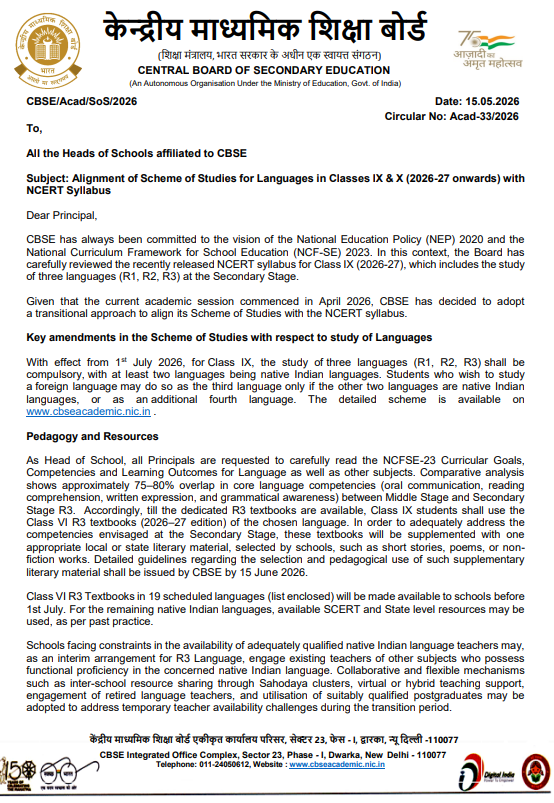
The Central Board of Secondary Education (CBSE) has announced a major change in the language curriculum for Classes 9 and 10. Through a circular issued on May 15, 2026, the Board confirmed that students studying in Class 9 from the 2026-27 academic session will have to study three languages as part of their regular timetable.
CBSE will implement the new rule from July 1, 2026. The Board has aligned this policy with the National Education Policy (NEP) 2020 and the National Curriculum Framework for School Education (NCF-SE) 2023.
 Join Our WhatsApp Channel
The Board described the decision as an important step towards promoting multilingual education, strengthening Indian languages, and improving language learning among students.
Students Must Choose at Least Two Indian Languages
Under the revised language structure, students will study three languages called R1, R2, and R3. CBSE has made it compulsory for students to select at least two native Indian languages among these three subjects.
Students may still choose a foreign language, but only if the other two selected languages are Indian languages. The Board has also allowed students to study a foreign language as an optional fourth subject.
CBSE said the policy supports the vision of NEP 2020, which encourages multilingual learning and promotes Indian languages at the school level.
CBSE Removes Board Exam Pressure for Third Language
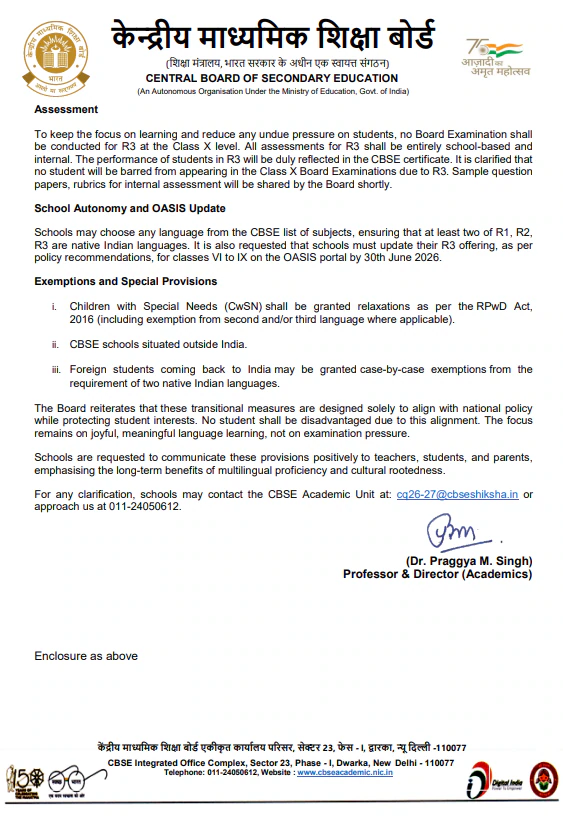
CBSE has clearly stated that students will not appear for a Class 10 Board examination for the third language (R3).
Instead, schools will conduct all assessments internally. Schools will evaluate students through classroom-based activities and internal examinations. The final performance in R3 will still appear in the CBSE certificate.
The Board has also clarified that no student will lose eligibility for the Class 10 Board exams because of the third language.
Connect with us on WhatsApp
CBSE said it introduced this decision to reduce unnecessary pressure on students and keep the focus on learning rather than examination stress.
Schools Will Focus on Communication and Practical Language Skills
CBSE has directed schools to develop practical language abilities instead of focusing only on textbook learning.
Schools will assess students on:
- Oral communication
- Reading comprehension
- Writing skills
- Grammar awareness
The Board said schools should encourage active language use through classroom discussions, reading activities, and written exercises.
CBSE will release sample question papers and detailed assessment guidelines separately.
CBSE Adopts Transitional Approach for 2026-27 Session
CBSE has decided to follow a transitional implementation plan because the academic session for 2026-27 already started in April 2026.
The Board said schools should gradually align their language teaching structure with the updated NCERT syllabus during this transition phase.
CBSE assured students, parents, and schools that no student would face disadvantage during the implementation period. The Board emphasized that schools should prioritise smooth learning and flexibility instead of strict enforcement during the first year.
Students Will Use Class 6 Textbooks for Third Language Initially
CBSE has instructed schools to use Class 6 textbooks for the third language temporarily until dedicated secondary-level textbooks become available.
The Board explained that around 75–80% of core language competencies remain similar between middle-stage and secondary-stage language learning. These competencies include reading, writing, speaking, and grammar development.
To improve learning at the Class 9 level, schools may also use:
- Short stories
- Poems
- Regional literature
- Non-fiction texts
- Supplementary reading materials
CBSE said it will release detailed pedagogical guidelines before June 15, 2026.
CBSE and NCERT Prepare Textbooks in 19 Indian Languages
CBSE and NCERT are currently developing Class 6 R3 textbooks in 19 scheduled Indian languages.
These languages include:
| Language | Language |
|---|---|
| Assamese | Bengali |
| Gujarati | Kannada |
| Malayalam | Marathi |
| Punjabi | Tamil |
| Telugu | Sanskrit |
| Odia | Konkani |
| Kashmiri | Nepali |
| Sindhi | Dogri |
| Maithili | Bodo |
| Santali | Punjabi |
CBSE said schools would receive these textbooks before July 1, 2026. For other Indian languages, schools may continue using SCERT and State-level study resources.
CBSE Allows Flexible Teacher Arrangements for Schools
CBSE acknowledged that some schools may face difficulty in finding qualified teachers for regional Indian languages.
To solve this challenge, the Board has allowed schools to adopt several flexible teaching methods.
Schools may:
- Use hybrid or online classes
- Share teachers through Sahodaya school clusters
- Appoint retired language teachers
- Use existing teachers from other subjects who know the language well
- Conduct collaborative teaching programmes
CBSE said these temporary measures would help schools continue language teaching smoothly during the transition phase.
Schools Must Update Language Details on OASIS Portal
CBSE has instructed all affiliated schools to update their selected language combinations and R3 offerings on the OASIS portal by June 30, 2026.
The Board asked principals and school administrators to carefully review the revised language scheme and ensure proper implementation before the July deadline.
CBSE Announces Relaxations for Special Categories of Students
CBSE has included several special provisions to ensure inclusivity and flexibility.
Children With Special Needs (CwSN) may receive exemptions from studying a second or third language under the RPWD Act, 2016.
CBSE has also allowed exemptions for:
- Foreign students returning to India
- International CBSE schools
- Special educational cases approved individually
The Board said schools should handle such cases with sensitivity and follow existing guidelines carefully.
CBSE Aims to Promote Multilingual Education Across India
Through this policy, CBSE aims to create stronger multilingual learning environments in schools across the country.
The Board believes that learning multiple languages will:
- Improve communication skills
- Strengthen cultural understanding
- Promote Indian languages
- Build cognitive and analytical abilities among students
CBSE has described the policy as one of the most significant curriculum reforms in recent years.
At the same time, the Board has tried to balance reform with practicality by reducing Board exam pressure, allowing flexible implementation, and giving schools enough time to adjust to the new structure.